.jpg)


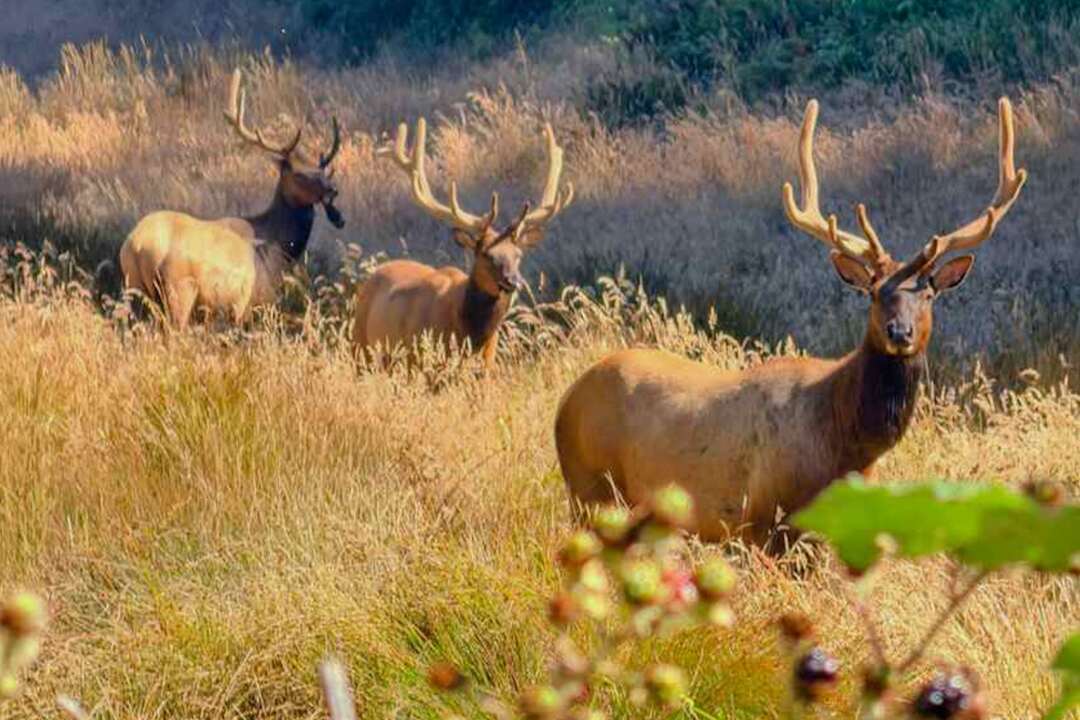
Roosevelt elk are the largest subspecies of elk in North America, and they move through Usal Redwood Forest in herds that can number in the dozens. Named after President Theodore Roosevelt, whose conservation policies helped save the species from near extinction, they remain one of the most visible signs of a working redwood ecosystem.
What Is a Roosevelt Elk?
A Roosevelt elk, or Cervus canadensis roosevelti, is the largest subspecies of elk in North America, with bulls weighing up to 1,100 pounds and carrying antlers that can spread more than four feet across. According to the National Park Service, Roosevelt elk once ranged along the Pacific coast from southern British Columbia south through Mendocino and Sonoma counties before unregulated hunting nearly wiped the population out. Unlike elk in drier, open country, Roosevelt elk favor forest edges, meadows, and river corridors, grazing on grasses, shrubs, and young tree growth. Herds are typically led by a dominant cow, and bulls compete for breeding rights each fall during a rutting season marked by bugling calls that carry across the property.
What Role Does the Roosevelt Elk Play in Usal's Ecosystem?
Elk grazing shapes the understory of a redwood forest by keeping meadows and forest edges open, which benefits everything from ground nesting birds to the pollinators that depend on those clearings for wildflowers. Their movement between forest and meadow also disperses seeds across the property as they travel between grazing sites. As a large grazing herbivore, elk sit near the top of the food chain and are, occasionally, prey for the mountain lions sharing this landscape, making them both a keystone species and a food source in the same ecosystem. Their browsing pressure also influences which shrubs and hardwoods can establish in a given clearing, indirectly shaping the mix of plant species available to every smaller animal in the same habitat.
Why Does the Roosevelt Elk Matter?
By 1925, the National Park Service recorded as few as 15 Roosevelt elk remaining in California, with one of the last herds surviving in what is now Prairie Creek Redwoods State Park. Market hunting during the California gold rush and the conversion of habitat into pasture and cropland had pushed the subspecies to the edge of extinction across its entire range. Protection efforts over the following century allowed populations to rebound to more than 1,000 animals in California alone. Seeing a herd move through Usal today is a direct result of that century-long recovery, and a reminder of how much habitat still needs to stay intact for the species to hold its ground.
See them for yourself on the guided ATV tour. Visit redwoodforests.org/atv-tour.
FAQ - Frequently Asked Questions
How much do Roosevelt elk weigh?
Bull Roosevelt elk can weigh up to 1,100 pounds, making them the heaviest of North America's elk subspecies. Cows are considerably smaller, typically ranging from 575 to 625 pounds. This size difference is most visible during the fall rut, when bulls carry the extra weight needed to compete for breeding rights.
Where can you see Roosevelt elk in California?
Roosevelt elk are found along California's North Coast, from Redwood National Park and Prairie Creek Redwoods State Park in Humboldt County south through Mendocino County, including Usal Redwood Forest. Herds favor forest edges, meadows, and river corridors, where visibility is best in early morning and evening.
What is the difference between Roosevelt elk and other elk subspecies?
Roosevelt elk are the largest of North America's elk subspecies, outweighing both Rocky Mountain elk and Tule elk, California's smallest subspecies found mainly in the Central Valley. Roosevelt elk also favor dense, wet coastal forest habitat, while Tule and Rocky Mountain elk are adapted to drier, more open terrain.
When is Roosevelt elk mating season?
Roosevelt elk rut in the fall, typically from September through October. Bulls bugle to assert dominance and attract cows, competing for control of a harem. This is the most active and vocal time of year to observe elk herds at Usal Redwood Forest and along the Mendocino Coast.
Are Roosevelt elk endangered?
No. Roosevelt elk are not currently listed as threatened or endangered. Populations were reduced to as few as 15 animals in California by 1925 due to unregulated hunting, according to the National Park Service, but a century of protection has allowed the subspecies to recover to more than 1,000 animals statewide.