.jpg)



.jpg)
Most people hear "fire in the forest" and picture loss. Blackened ground, hollowed trunks, a landscape reduced to ash. That instinct is reasonable, but it only describes one kind of fire. The other kind is older, slower, and it is how redwood forests on this coast have stayed healthy for thousands of years.
Redwood forest restoration often involves cultural fire, a low-intensity controlled burn practiced by Indigenous communities for generations to reduce ground fuel, restore native plant systems, and prevent the kind of high-severity wildfires that destroy forests outright. Understanding the difference between these two kinds of fire is the starting point for understanding how redwoods survive, and why restoration work in California looks the way it does today.
What Is Actually Happening in California's Redwood Forests ?
Across the coast redwood range, the forest floor has changed in ways that are not obvious unless you walk it. A century of aggressive fire suppression has allowed dry debris to accumulate layer after layer. Fallen branches, dead needles, and dense understory now form a continuous blanket of fuel across ground that used to burn lightly every decade or so.

At the same time, stands have grown dense and uneven. Douglas-fir has moved into areas that were historically open meadow, mature oak, and hardwood. Native species that once thrived in the understory have been crowded out. The forest looks full from the outside, but inside the system it is out of balance, and it has become more vulnerable to the kind of fire that takes entire canopies at once.
This is the condition that restoration work is responding to. The problem is not that fire returned. The problem is that the wrong kind of fire is now the only kind the forest is prepared to receive.
Not All Fire Is The Same.
There are two fundamentally different fires moving through forests in California, and they behave in opposite ways.
Cultural fire moves low and slow across the ground. It clears the litter and small fuels without reaching the canopy, and it leaves mature trees standing. Its purpose is to restore the forest to a condition where it can absorb future disturbance without collapsing. The result is a forest floor that is open, a soil layer that holds more moisture, and an understory where native plants return on their own.
Wildfire, under current conditions, is the opposite. It runs hot, climbs into the canopy, and consumes everything in its path. When fuel has built up for decades, a single ignition can behave this way almost immediately. What looks like the same phenomenon from a distance is actually two different processes with two different outcomes, and the distinction is what determines whether a forest survives or not.
Why Cultural Fire Matters ?
For thousands of years, Indigenous nations across what is now California, including the Karuk, Yurok, Wailaki, and Hoopa, used fire as a tool of stewardship. Low, careful burns were set at specific times of year to clear accumulating fuel, open ground for native plants, and maintain the conditions that supported food, medicine, and materials for cultural use.
This was not intervention in the ecological sense. It was continuity. The redwood forest and the people living inside it evolved together under a pattern of regular, small fires. When that pattern was broken by colonization, fire suppression policy, and the forced removal of Indigenous communities from the land, the forest lost the one process that had kept it in balance. What has accumulated since is not a return to wilderness. It is the visible absence of stewardship.
Bringing cultural fire back is not a matter of technique alone. It is the return of a practice and a relationship that predates any forest agency by generations.
What Redwood Forest Foundation Is Doing Differently ?
At Usal Redwood Forest, restoration work is grounded in partnership rather than prescription. The foundation manages 50,000 acres of coast redwood forest on the Mendocino Coast, and the restoration approach here treats the forest as a system to work with, not a resource to control.
Cultural fire is being reintroduced at sites like Parker Flat in partnership with Wailaki Cultural Burn Practitioners, with support from local Volunteer Fire Departments, CAL FIRE personnel, and Prescribed Burn Association members. The focus is on reducing fuel at the ground level, opening space for native plants to return, and pushing back the Douglas-fir encroachment that has overtaken historically open grassland and hardwood ecosystems.
This is long-term work. The goal is not a single burn or a single season. It is the slow return of a functioning fire cycle at the scale of a working forest.
A Closer Look: The Cultural Burn At Parker Flat.
On Sunday, March 29, a cultural burn at Parker Flat covered approximately 28 acres inside Usal Redwood Forest. It was led by Wailaki Cultural Burn Practitioners, with support from CAL FIRE, local Volunteer Fire Departments, and members of the Prescribed Burn Association.
The burn cleared dense understory, reduced accumulated debris, and began opening space for native plant systems to recover. It also marked the first phase of a five-year stewardship plan focused on reducing Douglas-fir encroachment into meadow, mature oak, and hardwood ecosystems. Many of the plants expected to return in the seasons after a burn like this are species used for generations by Native communities for food, medicine, and basket weaving. The deeper purpose of the work is not only fuel reduction. It is the active return of the land to a condition it needs in order to stay healthy.
What changes after a burn is not always dramatic on the surface. The shift happens at ground level. Fuel is reduced, light reaches the forest floor, and native species begin to come back. Resilience in a forest this old is built slowly, in layers, over seasons.

Fire, Time, and The Resilience of Redwood Trees.
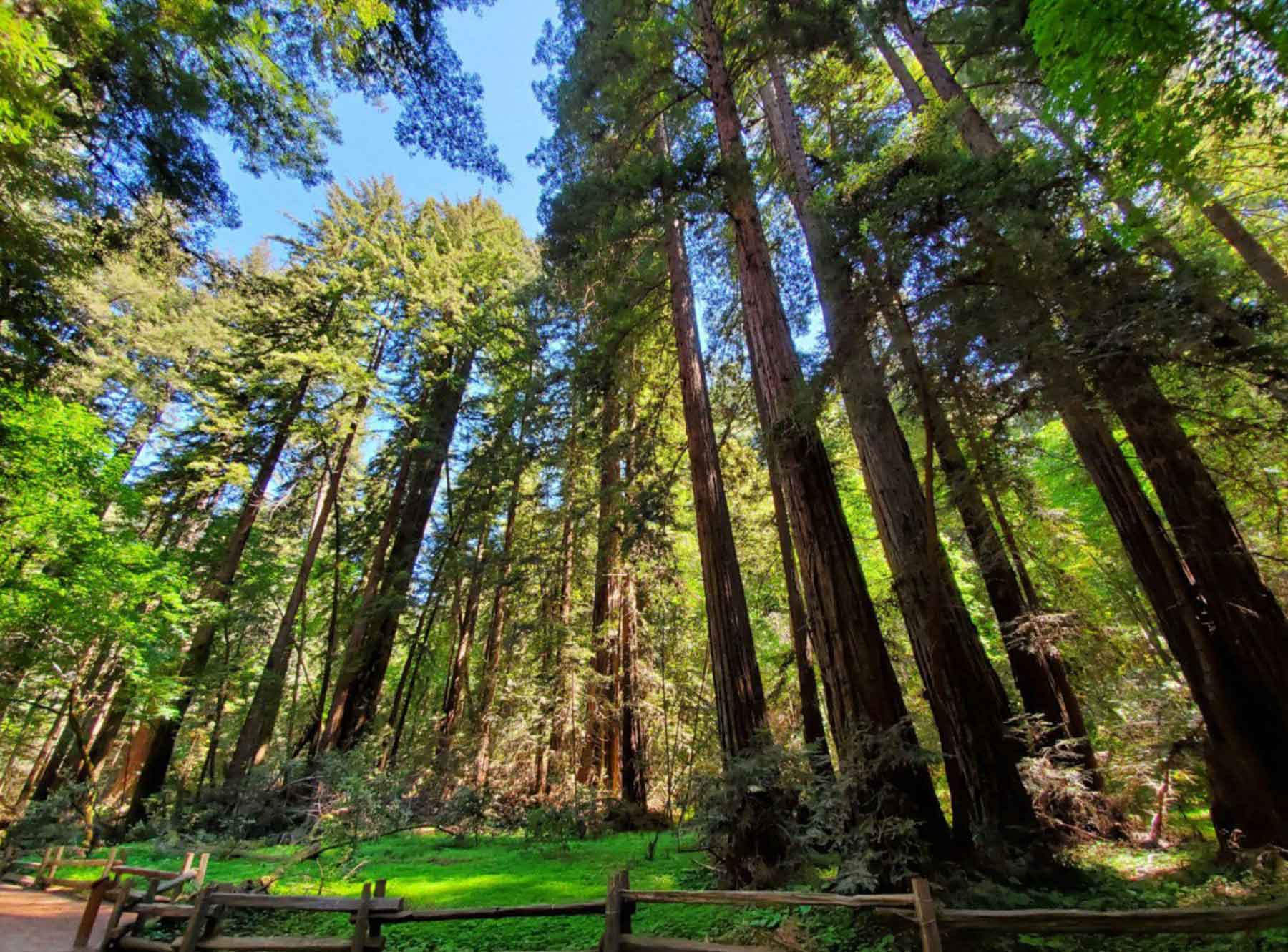
Some of the redwoods standing at Usal today have already lived through multiple fires across centuries. Their cores may be hollowed. Their bases may be charred black. Yet their canopies remain green, and new growth continues above ground that has burned more than once.
This resilience comes from structure. Redwood bark grows up to a foot thick and contains almost no resin, which is what makes most other trees ignite quickly in a fire. The bark is tannin-rich and absorbs heat before it can reach the living tissue underneath, and as long as that inner cambium stays intact, the tree keeps drawing water from the soil and feeding the canopy above. In many of these trees, what fire carved out over the centuries has become habitat for bats and owls. The forest does not only survive fire. It incorporates it.
This is why restoration under current conditions matters so much. The trees themselves are built to handle fire in its historical form. What they are not built to handle is a canopy fire fueled by a century of suppressed ground cover. Restoration is not about protecting the redwoods from fire. It is about returning fire to the form the redwoods evolved alongside.
What Needs To Happen Next ?
Restoring fire to forests at a meaningful scale requires coordination across landowners, agencies, tribal partners, and communities. It requires policy support, sustained funding, and trained practitioners who can carry the work forward over years rather than seasons. Most of all, it requires a shift in how the public understands fire itself.
Fire cannot remain categorized as purely destructive in the cultural imagination, because that framing makes restoration politically difficult and keeps the system stuck in the cycle that produced the current risk. The forests can recover, but the conditions for recovery have to be created deliberately, and that work only scales if enough people understand why it is happening.
How To Be Part of Redwood Forest Restoration ?
There are real ways to engage with this work. Learning how cultural fire functions, and why the distinction between cultural fire and wildfire matters, is the starting point. Supporting organizations that are advancing restoration in partnership with Indigenous practitioners helps that work continue. Visiting working forests like Usal and seeing the land firsthand shifts restoration from an abstract idea to something grounded in a specific place. Sharing accurate information about fire and forest health is one of the most useful things anyone can do, because the cultural shift around fire will not happen inside agencies alone.
Restoration is not a single action. It is sustained involvement over time, and it works best when many people carry a small part of it together.
Closing
Fire has always been part of the redwood forest. The question is not whether it belongs here. The question is how it is used, and by whom. Left unchecked under current conditions, fire destroys. Applied with knowledge by the people who have understood this land the longest, it restores. The future of these forests depends on whether enough of us can see that difference clearly.
FAQ - Frequently Asked Questions
Does fire always destroy forests?
No. Low-intensity cultural fire clears ground fuel and leaves mature trees standing, while high-intensity wildfire, fueled by decades of fuel buildup, burns hot into the canopy and destroys the forest.
What is cultural fire?
Cultural fire is a low-intensity, controlled burn practiced by Indigenous communities for generations to reduce ground fuel, restore native plants, and prevent severe wildfires.
Why do redwood forests need fire?
A century of fire suppression has let debris and dense understory build up, crowding out native plants and making forests more vulnerable to canopy-destroying wildfire. Reintroducing low, controlled fire restores balance.
Can redwood trees survive fire?
Yes. Redwood bark grows up to a foot thick, contains almost no resin, and absorbs heat before it reaches the living tissue inside, letting the tree survive even after repeated fires.
What is Redwood Forest Foundation doing about cultural fire?
RFFI is reintroducing cultural fire at sites like Parker Flat in partnership with Wailaki Cultural Burn Practitioners, CAL FIRE, and local fire departments, as part of a five-year stewardship plan.